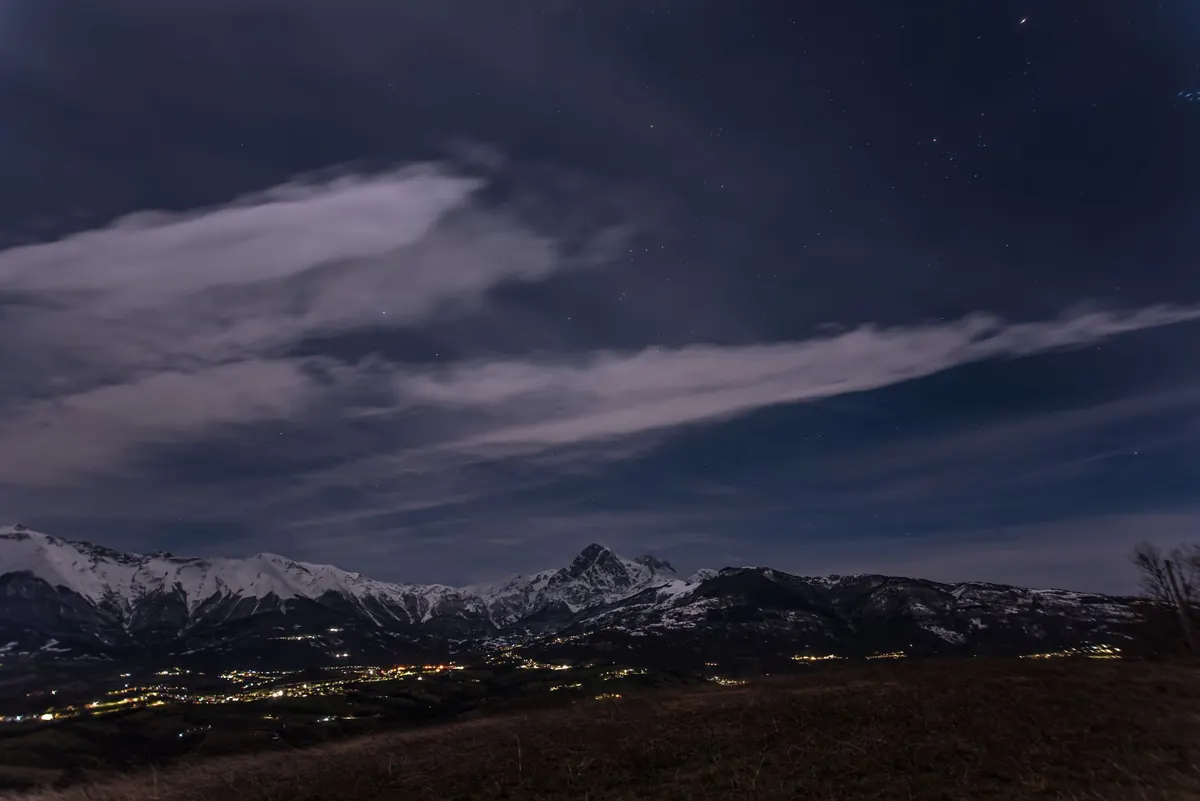
Orion is one of the few constellations that looks like its nickname: a hunter with broad shoulders, a bright belt, and a sword hanging below. That sword contains the Orion Nebula, a glowing cloud of gas and dust that is bright enough to see with ordinary binoculars and rewarding in even a small telescope. The trick is not expensive equipment. It is knowing where to look, when Orion is well placed, and how to use low power and patience. This guide gives you a simple star-hop that works from a suburban garden, a city balcony, or a darker field. You do not need a perfect sky or a large scope; you need a clear view of the Belt, a steady place to rest your arms, and a few minutes for your eyes to adjust.
Start with the shape you already know
From mid-northern latitudes, Orion is a winter evening constellation: it climbs into the east late in the year, stands high on January evenings, and sinks into the west by spring. From southern latitudes the same season is summer, and Orion appears upside down, but the pattern is just as clear. If you are unsure, go out when the constellation is at least a handspan above the horizon. Low Orion is blurred by atmosphere and streetlights; a little altitude makes a large difference. A constellation that is only just clearing the rooftops will often look disappointing, while the same stars higher in the sky can reveal the sword and its fuzzy centre with little effort.
Find the three stars of the Belt first. They are close together, evenly spaced, and hard to mistake. Above and below them you will see the brighter shoulders and knees: Betelgeuse, a warm orange star, and Rigel, a blue-white one. The Belt is your signpost. The sword hangs from it on the side where the fuzzy patch lies—below the Belt as seen from mid-northern latitudes, above it from many southern sites. You do not need to memorize star names to use the Belt. You only need to follow it. In fact, the Belt is one of the most useful landmarks in the whole sky because it is bright enough to survive light pollution, yet distinctive enough to point you toward fainter objects.
Before you raise binoculars, look at Orion with your naked eye for a minute or two. Let your eyes relax. The sword is a short, faint line of stars that looks slightly smudged, as if someone has breathed on the sky. In a dark site it is obvious; in a town it may be only a hint. That faint smudge is exactly what you are hunting. If you can see it without optical aid, you will find it instantly in binoculars. If you cannot, use the Belt as a ruler and let the binoculars do the work.
What binoculars and a small scope actually show
Any decent binoculars will show the Orion Nebula. Common sizes such as 7x50, 8x42, and 10x50 are all useful; the first number is magnification, the second is the width of the front lenses in millimetres. A 10x50 gives a little more reach, while a 7x50 is easier to hold steady. An 8x42 is a good compromise for many people: light enough to carry, wide enough to find the sword, and bright enough to show the nebula as more than a point of light. Avoid very high magnification in small binoculars. It narrows the field, magnifies every wobble in your hands, and makes a large, soft object like the Orion Nebula harder to find, not easier.
Through binoculars the sword becomes a line of faint stars with one noticeably fuzzy “star” in the middle. That fuzz is M42, the main part of the Orion Nebula. Under a dark sky it looks like a small grey-green cloud; under bright skies it may be only a soft glow. With a little patience you may notice a darker notch or lane cutting into the brighter part, and a smaller companion patch nearby called M43. These details come and go with sky conditions and with how steady you can hold the binoculars, so do not worry if your first view is modest. A faint grey smudge in the right place is a successful observation.
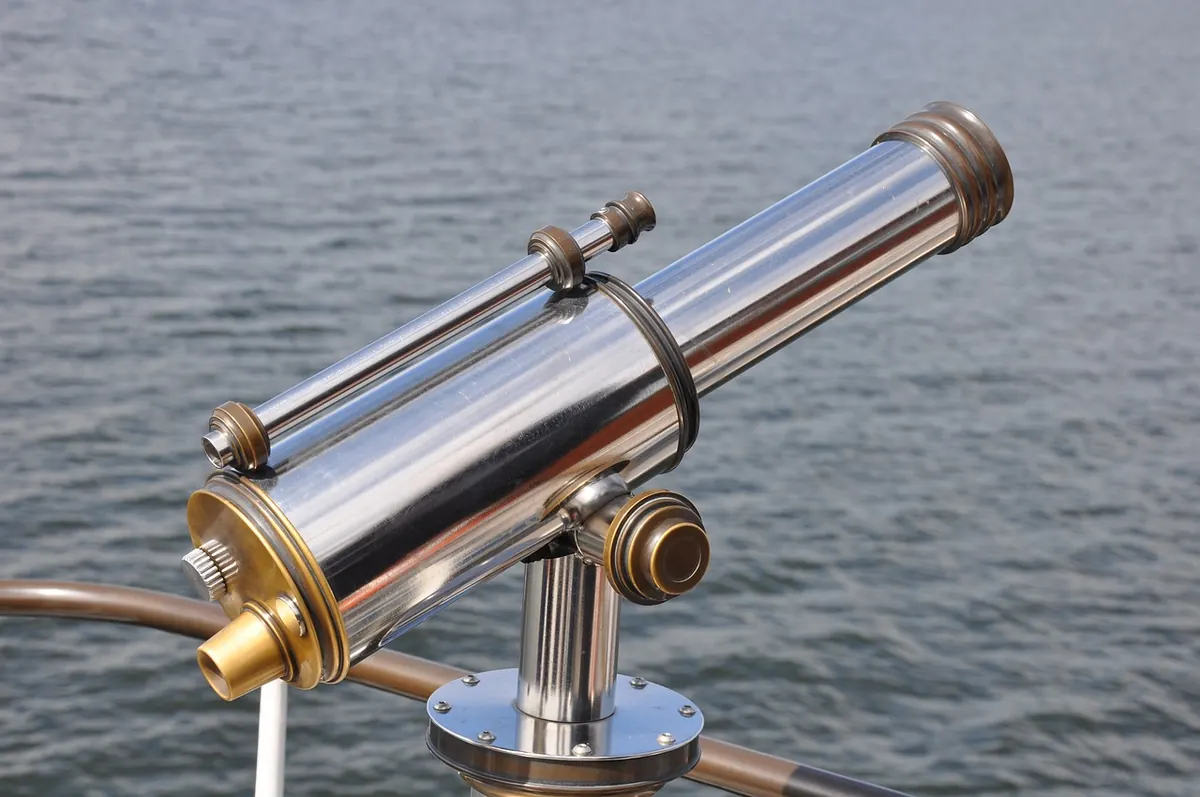
A small telescope—say a 60mm to 80mm refractor or a compact reflector—shows more shape at low power. You may see the Trapezium, a tight group of young stars at the nebula’s heart, and the brighter wings of the cloud stretching away from them. Do not expect the vivid colours of long-exposure photographs. The human eye is poor at colour in dim light, so the nebula usually appears grey or faintly green. What you lose in colour you gain in connection: the light entering your eye left that cloud long before you were born. A low-power eyepiece giving about 20x to 30x is ideal for the first look. It keeps the whole nebula in view and makes the star-hop forgiving. Once you have found M42, you can try slightly more magnification, but many observers find that the best view is the one that shows the nebula together with the stars of the sword.
Star-hop from the Belt to the Sword
Use the Belt as your starting line. The sword is close, but it is easy to drift past it if you sweep the sky at random. A deliberate star-hop is faster and more satisfying.
- Find the three Belt stars with your naked eye and face them comfortably.
- Raise your binoculars and centre the middle Belt star in the field of view. Keep both eyes open if you can; it is less tiring and helps you stay oriented.
- Slide the binoculars slowly away from the Belt, perpendicular to the line of the three stars, toward the side where the sword hangs. From mid-northern latitudes that means moving below the Belt; from many southern locations it means moving above it.
- Move only one or two finger-widths at arm’s length. Look for a short line of faint stars. One of them will look thicker, softer, or slightly out of focus compared with its neighbours. That is M42.
- Centre the fuzzy star and hold still. Give your eyes a few seconds to settle. Use averted vision—look slightly to one side of the nebula—and the brighter part may seem to grow.
If you are using a telescope, start with the finder scope or a very low-power eyepiece. Align the finder on the middle Belt star, then move in the same direction you would with binoculars. Remember that a star diagonal may flip or mirror the view, so do not rely on “up” and “down” in the eyepiece. Instead, think in terms of moving away from the Belt toward the sword. Once the sword is in the field, centre the fuzzy middle star and focus carefully. A telescope at 25x will often show the Trapezium as three or four tiny stars embedded in haze, with the brighter wings of the nebula extending around them.
The most common mistake is using too much magnification too soon. High power narrows the field and turns a large, low-contrast cloud into a dim patch that is hard to recognise. If you get lost, go back to the Belt and start again. The sword is not far, and the return trip takes only a few seconds. Another common mistake is sweeping too quickly. The nebula does not jump out like a bright planet; it appears as a soft, slightly irregular glow among stars. Slow, small movements work better than wide, hurried sweeps.
Make the view better
Dark adaptation matters more than people expect. Give your eyes ten to twenty minutes away from bright screens and white lights. Use a red flashlight if you need one, and shield your eyes from nearby streetlights with a hand, a hood, or the side of a building. A full Moon is beautiful but unhelpful for the Orion Nebula; if the Moon is bright, try another night or look when Orion is higher and the Moon is lower. Even in a city, the Belt and sword are often visible, but the nebula may shrink to a faint smudge. That is normal. The goal is to see it, not to match a photograph.
Steadiness is the other half of the trick. Hand-held binoculars will always tremble a little, but you can improve the view by bracing your elbows on a wall, leaning against a fence, or sitting in a reclining chair. A simple binocular tripod adapter can transform the experience, especially with 10x50s. For a small telescope, use the lowest useful power and make sure the tripod is on firm ground. Tap the tube gently and watch the image settle; if it keeps shaking, something is loose or the tripod is too light.
- Use averted vision. Look slightly to the side of the nebula and let the fainter parts register at the edge of your vision.
- Observe for several minutes. The Orion Nebula rewards time; details appear as your eye adapts and your brain learns what to look for.
- Keep both eyes open. This is especially helpful with binoculars and reduces eye strain.
- Avoid phone screens. A single bright screen can undo several minutes of dark adaptation.
What you are actually seeing
The Orion Nebula is a vast star-forming region about 1,300 to 1,400 light-years away. The bright part you see is lit and sculpted by young, hot stars, including the Trapezium cluster at its heart. The dark lane that cuts across the bright cloud is not a gap in the nebula but a dense band of dust blocking the light behind it. M42 is the main nebula; M43 is a smaller companion region separated by a dark lane. Together they are part of the larger Orion Molecular Cloud, a cold, dusty complex where new stars are still being born.
That faint grey-green glow is therefore not just a pretty cloud. It is a nursery. The Trapezium stars are only a few hundred thousand years old—infants in astronomical terms—and their radiation is shaping the gas around them. When you look at M42 through binoculars, you are seeing across more than a thousand light-years into a place where stars are forming right now. The view may be faint, but the story is enormous.
When and where to look
From mid-northern latitudes, Orion is best on evenings from December through February, with January offering some of the most convenient views. In late autumn it rises before dawn; by early spring it is sinking in the west after sunset. From southern latitudes, Orion is a summer constellation and stands high in the evening sky during December and January, though it appears upside down compared with northern views. Wherever you are, wait until Orion is clear of buildings and trees. A few degrees of altitude can be the difference between a mushy glow and a crisp nebula.
Choose the darkest spot you can reach easily. A garden, a park, or a quiet field is better than a street corner under a lamp, but you do not need a remote dark-sky site to begin. If you can see the Belt, you can probably find the sword. If you can see the sword faintly with your naked eye, binoculars will show M42 well. On a moonless night after a cold front has cleared the air, the view can be surprisingly detailed even from a suburban garden.
Troubleshooting common problems
- I can see the Belt but not the Sword. Move more slowly and check that you are moving on the correct side of the Belt. Shield your eyes from nearby lights and give yourself more dark-adaptation time.
- The nebula looks like an ordinary star. It may be slightly out of focus or you may be looking at the wrong star in the sword. Look for the one that appears fuzzy or thicker than its neighbours.
- Everything shakes. Brace your elbows, sit down, or use a tripod. Lower magnification also helps.
- The telescope shows nothing. Check the finder alignment in daylight, then use the lowest-power eyepiece. Do not start with high magnification.
- The nebula has no colour. That is normal for visual observing. The eye sees dim objects mostly in grey, and colour photographs use long exposures and processing.
A simple observing plan
- Go out after dark and let your eyes adapt for at least ten minutes.
- Find the three Belt stars with your naked eye.
- Look below the Belt—or above it from southern latitudes—for the faint sword.
- Raise binoculars, centre the middle Belt star, then slide slowly toward the sword.
- Find the fuzzy star in the middle of the sword. That is M42.
- Hold steady, use averted vision, and observe for several minutes.
- If you have a small telescope, switch to a low-power eyepiece and centre the same spot.
- Look for the Trapezium, the dark lane, and the brighter wings of the cloud.
The Orion Nebula is one of the most accessible wonders in the night sky. It asks for no special filters, no large aperture, and no long drive. It asks only that you find the Belt, follow the sword, and give your eyes a little time. Once you have made that short star-hop, you will never need to search for it again; Orion’s Belt will always point the way.
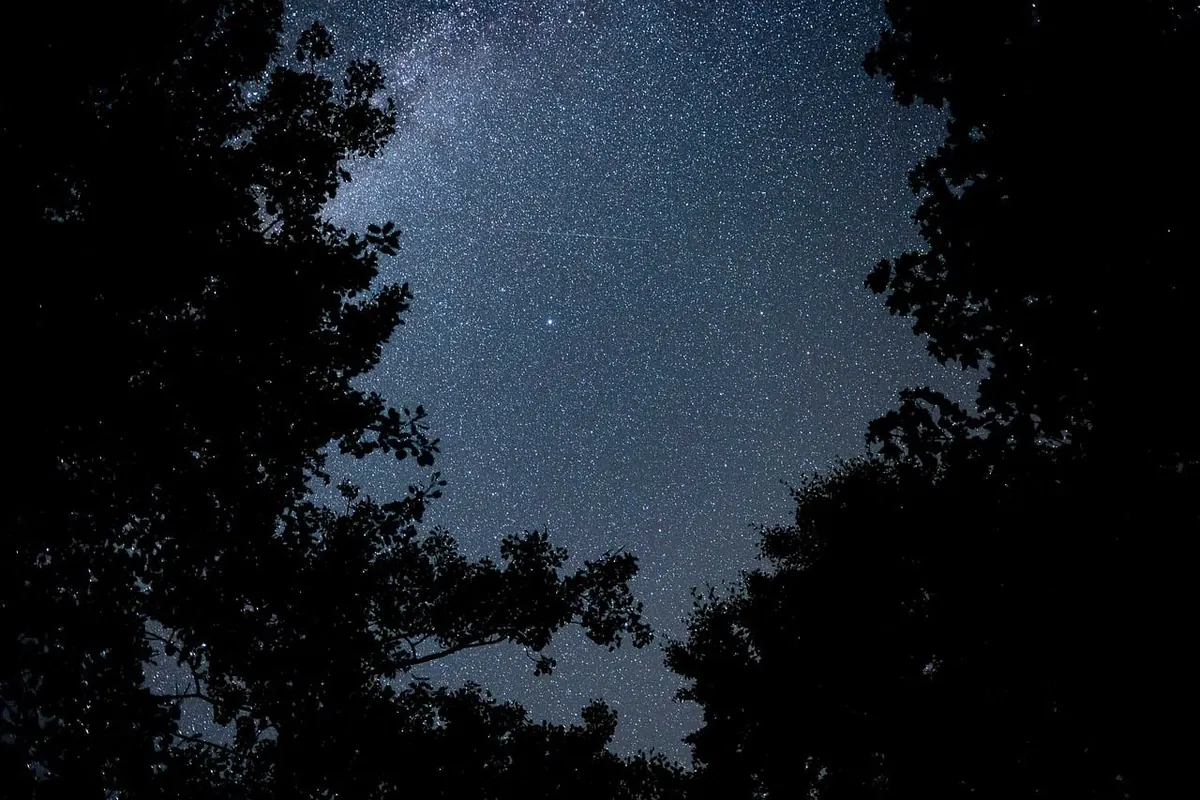
Photo: Compose_the_Seen / Pixabay